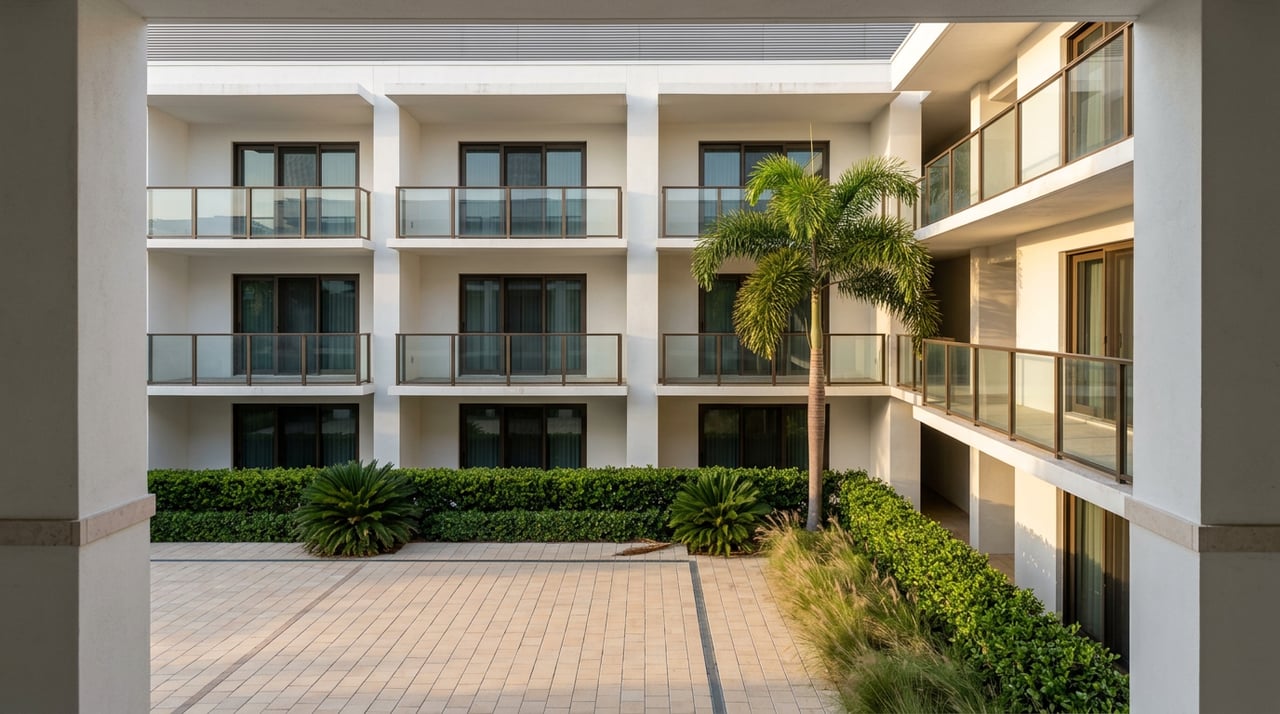
If you pulled up two downtown Sarasota condo listings this month, both priced in the low $700s, both with water glimpses, both sitting in buildings built within a few years of each other, you might expect them to behave the same way. One goes under contract in three weeks at nearly full price. The other sits. The seller cuts. It sits again.
Ask why, and most agents will point you to the same explanation everyone in this market repeats right now: too much new construction, too many older buildings caught up in Florida's post-Surfside reserve laws, and a buyer's market settling over downtown condos as a result. That story isn't wrong. It's just incomplete, and the part it leaves out is the part that actually determines which of those two listings sells first.
The number doing the heavy lifting
Downtown Sarasota's own listing data as of March 2026 painted a picture that looked, on paper, remarkably calm. Median list price sat at $1,037,000 across 125 active condo listings, with a median 109 days on market and sellers landing 94 percent of their asking price, a read classified as a balanced market rather than a buyer's or seller's tilt.
Zoom out to the county level and the tone shifts. Sarasota County's broader condo segment carried 8.6 months of supply as of March 2026, well above the roughly 5.5 months industry benchmarks treat as balanced, with a median list-to-sale ratio of 92.1 percent. RASM's April 2026 report showed 2,300 active condo listings and 7.7 months of inventory countywide, with sellers realizing 91.1 percent of original list price. RASM's February 2026 report recorded 322 closed condo and townhome sales, up 35.9 percent year over year, at a median sale price of $330,000, down 3.5 percent from the prior February.
Here's the part that should catch your attention. Downtown's own 94 percent sale-to-list ratio is running higher than the county's 91 to 92 percent average, in the same window everyone agrees is the softest condo market Sarasota has seen in years. If the aging, reserve-strained buildings downtown were the ones dragging the county number down, downtown's blended figure should look worse than the county average, not better. It doesn't. That gap is the tell that the downtown "average" is quietly blending two markets that behave nothing alike.
What the blended number is hiding
Florida's 2022 post-Surfside legislation, commonly known as SB 4-D, requires condominium buildings three stories or taller to complete a structural integrity reserve study and a milestone inspection, and to fund reserves accordingly. Buildings that spent years letting owners vote to waive reserve contributions are now catching up all at once, and that catch-up shows directly on monthly statements. Some downtown buildings have seen HOA fees climb 40 to 50 percent since 2022, and buildings that fail an inspection or arrive at closing with underfunded reserves can face special assessments running into five figures per unit.
That single fact changes who can even buy into a given building. Financing for a condo with unresolved reserve status or a pending structural inspection is either unavailable or priced so far outside normal terms that it pushes financed buyers out of the running entirely. Cash buyers made up 68.0 percent of Sarasota County condo transactions in February 2026, compared to 47.0 percent of single-family purchases the same month, and cash's share of condo deals climbed further to 70.1 percent by April 2026. That's not a coincidence. It's the mechanism. A building working through compliance loses its financed buyer pool overnight, leaving only cash buyers willing to absorb the uncertainty, usually at a discount and usually with more patience than urgency.
A compliant building keeps its whole buyer pool. Financed buyers can still qualify. Cash buyers still show up because cash buyers show up everywhere in this market. That building's days on market stays short and its sale-to-list ratio stays high, not because the building is newer or flashier, but because nothing about financing it is complicated.
The paperwork is the risk, not the price tag on the unit.
The towers quietly resetting what "current" means
While that sorting plays out inside individual buildings, downtown's skyline is adding a genuinely large volume of new supply, staggered over several years rather than arriving all at once.
The Edge at 290 Cocoanut, a 10-story building from Jebco Ventures with just 27 residences ranging from roughly 3,150 to 3,530 square feet, topped out in December 2025 and is on track for delivery in late 2026. The Ritz-Carlton Residences Sarasota Bay, at 555 Quay Commons, is a 20-story, 78-residence tower with floor plans from 3,500 to nearly 6,000 square feet, pricing starting around $3.7 million, and property management handled directly by The Ritz-Carlton, also delivering late 2026. One Park at The Quay is expected in early 2027. The Waldorf Astoria Residences, an 18-story, 86-unit tower planned for Five Points at Main and Pineapple, is a joint project of Jebcore Companies and WMG Development under a Hilton brand license, with units starting at $2.2 million, groundbreaking planned for spring 2027 and delivery in 2029.
| Project | Delivery | Scale | Entry price |
|---|---|---|---|
| The Edge at 290 Cocoanut | Late 2026 | 10 stories, 27 residences | Not published |
| Ritz-Carlton Residences Sarasota Bay | Late 2026 | 20 stories, 78 residences | Starting near $3.7M |
| One Park at The Quay | Early 2027 | Not published | Not published |
| Waldorf Astoria Residences | Groundbreaking spring 2027, delivery 2029 | 18 stories, 86 residences | Starting at $2.2M |
None of these towers deliver on the same date, and that staggering matters more than the combined unit count. Instead of a single glut hitting the market at once, downtown gets a rolling series of fully compliant, newly built comparables entering the picture every few quarters, each one resetting what a financed buyer or an appraiser treats as the current standard for a downtown Sarasota condo. Older buildings aren't competing against one wave of new inventory closing on a single date. They're competing against a moving target that gets a little newer, a little more compliant, and a little easier to finance every year.
What this actually means if you're comparing two units at the same price
If you're weighing a downtown condo against a barrier-island alternative, or comparing two downtown units that look identical on a listing sheet, the purchase price is the least useful number you have. Before you let two similar prices convince you the buildings are similar risks, ask for four documents:
- The completed structural integrity reserve study, or documentation of where the building stands in that process.
- The milestone inspection report, if the building has reached the age threshold that requires one.
- The association's current reserve funding percentage, not just the headline HOA fee.
- Board meeting minutes from the past twelve to eighteen months, specifically looking for any mention of a pending or discussed special assessment.
A seller in Florida is required to provide the structural integrity reserve study, the milestone inspection report, and association financial documents before closing. If a listing agent hesitates on any of the four, that hesitation is itself information.
For a second-home buyer weighing the walkable, culture-forward version of Sarasota against a Gulf-front alternative, the calculus is straightforward once you separate the building from the blended market number. A compliant, financeable building in a softening market still behaves like a seller's market inside its own four walls, because the buyer pool for it never shrank. An older building still working through SB 4-D compliance may offer real upside for a cash buyer with patience, but it is not the same asset as its downtown neighbor, even if this month's list price says otherwise.
Is a lower asking price ever just a lower asking price downtown? Sometimes. But given how directly reserve status now determines who can finance a unit, a meaningfully lower price relative to comparable buildings is worth treating as a question rather than a discount until the reserve study says otherwise.
Should a buyer wait for the new towers to deliver before buying downtown? Not necessarily. The staggered delivery schedule means there is no single moment when the market resets. A compliant, well-managed older building today competes just fine against a tower delivering in 2027, because financeability, not age, is what separates the two segments.
Downtown Sarasota's blended numbers will keep looking calm for as long as new, compliant supply keeps entering the pipeline on schedule. The real story for anyone shopping this market right now isn't the average. It's which side of the reserve-and-inspection line the specific building you're touring falls on, and that's a building-by-building question no headline statistic can answer for you.
If you're weighing downtown Sarasota against the barrier-island markets we know best, or want a second set of eyes on a specific building's reserve documents before you write an offer, The Meyer Team can help you read the paperwork the way we read a seawall inspection. Browse Homes to see what's currently on the market across Sarasota and the surrounding barrier islands.